
Every organization will eventually face change, and the companies that thrive are the ones that prepare for it and manage it intentionally. In today’s accelerating business environment, the ability to navigate change is a survival skill.
Most organizations treat change as an event to survive instead of an opportunity to build toward something better. Companies that take a proactive and practiced approach rather than a reactive one are much more likely to survive and grow. Through strong change management practices, an organization can develop skills that allow them to adapt faster, waste less, and hold on to their talent and clients.
Kodak and Polaroid once dominated their industries, yet both failed to adapt as digital photography reshaped the landscape. Blackberry was the communication device of choice for millions before the iPhone made it obsolete. Netflix embraced change and reinvented itself; Blockbuster didn’t and disappeared. Even the most successful companies can fail is they don’t learn to adapt.
“Change before you have to.” — Jack Welch
Knowing when a change is needed is what gives an organization a competitive edge. Being prepared for change can be taken to the extreme, where leaders who are overly risk-activated may jump into change too quickly, creating unnecessary disruption. On the other end, risk-averse leaders may resist change until it’s too late.
The most effective leaders evaluate the need for change regularly, gather input from the people closest to the work, and make changes with purpose.
Why Change Management Matters
It’s commonly cited that 50–70 percent of change initiatives fail, and the reason comes down to poor change management. And beyond that, it can also mean missed deadlines, cost overruns, damaged customer relationships, and deep erosion of employee trust. Too often companies focus on the end result of change rather than on the process, asking people to jump to a destination without thinking about the effects the journey will have on them, both practically and psychologically.
An example of how poorly-handled change management can erode trust comes from a major leadership development company that went through layoffs and abruptly shut off a team member’s computer within five minutes of the call notifying him of his termination. They gave him no warning or space to process, and it sent a message to every employee watching that the organization did not value the human beings within it. That instance shattered the trust of many team members.
This story illustrates what happens when organizations plan the outcome of a change but not the experience of it. Leaders who think through both reduce the potentially catastrophic fallout of announcing a change without preparing their teams for it. They tell people what they know as soon as they know it, give employees time to ask questions before decisions are finalized, and build in checkpoints to address what isn’t working. This approach protects far more than most companies realize.
What Does Strong Change Management Look Like?
Strong change management shapes how people experience transitions. It influences their engagement, trust in leadership, and willingness to commit to the organization’s future. Leaders who manage change well allow their teams space to process the psychological and practical effects of the change and help them navigate toward acceptance.
Change management is ultimately about people. Adapting to change is a skill set, and some people are more skilled at adapting than others. The best leaders are able to assess what their team members are experiencing and help them build the skills needed to face the change and get on board with it. When leaders invest in their teams’ capacity to handle change, they invest in the organization’s future resilience.
The leaders who handle this best diagnose their teams before they communicate. They figure out where each team member sits on the adaptation curve, identify who is stuck and why, and address the practical and emotional blockers separately, because those require different responses. An employee who lacks information needs facts. An employee who has the facts but fears the outcome needs a different kind of conversation. Treating those two people the same makes change communication break down and can increase resistance.
The Business Case for Getting It Right
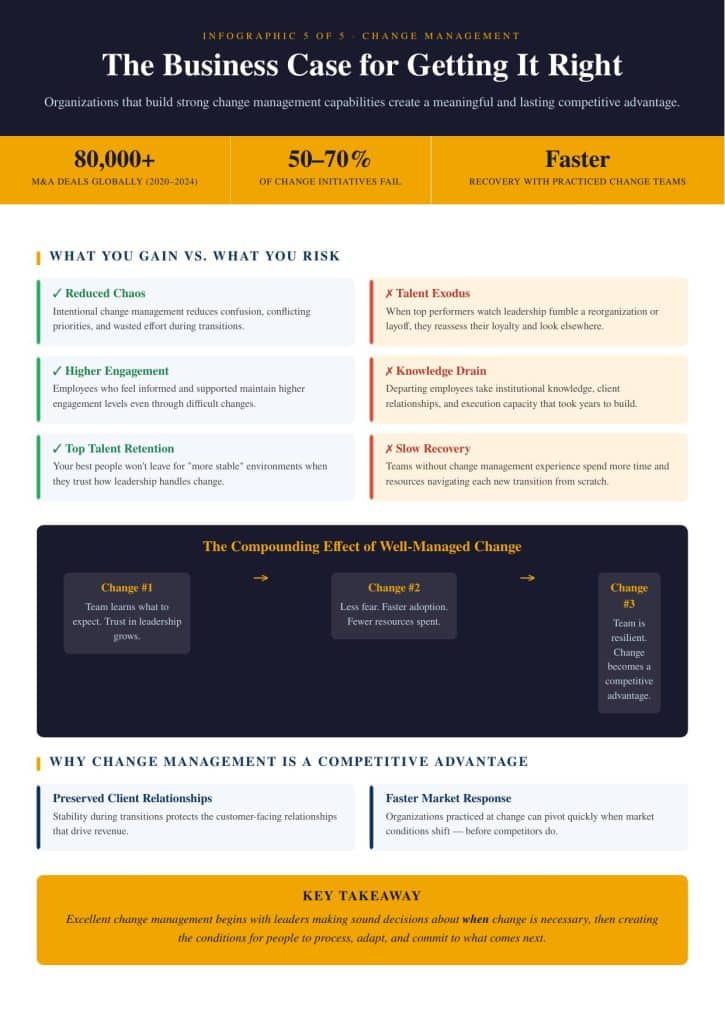
With over 80,000 mergers and acquisitions reported globally between 2020 and 2024 alone, organizational change is a constant feature of business life. Organizations that build strong change management capabilities create a meaningful competitive advantage. They reduce chaos, maintain higher employee engagement during transitions, and keep top talent who might otherwise leave for more stable-feeling environments.
When a company’s best people watch leadership fumble a reorganization or a layoff, they reassess their loyalties and may look for other opportunities. Strong change management holds talent in place, which helps retain the institutional knowledge, client relationships, and execution capacity that took years to build.
Organizations that handle change well also recover faster when change is forced on them, whether by market shifts, leadership turnover, or economic pressure. A team that has experienced well-managed transitions before knows what to expect, trusts that leadership will communicate, and spends less time and resources enacting change. Each well-handled change makes the next one easier.
| Key Takeaway: Excellent change management begins with leaders making sound decisions about when change is necessary and then creating the conditions for people to process, adapt, and commit to what comes next. |