
When an organization’s leaders announce a change, employees immediately want to know two things: why this is happening, and whether their perspective matters. As a leader, how well you answer those two questions determines whether your initiative succeeds.
These two principles can be described as clear vision and purpose, and information and inclusion.
Vision and purpose give people a direction to move toward, even when the transition is uncomfortable. Information and inclusion give them a reason to trust you through it. If either of these is lacking, it’s likely to lead to employee resistance, disengagement, and productivity loss.
Vision and Purpose
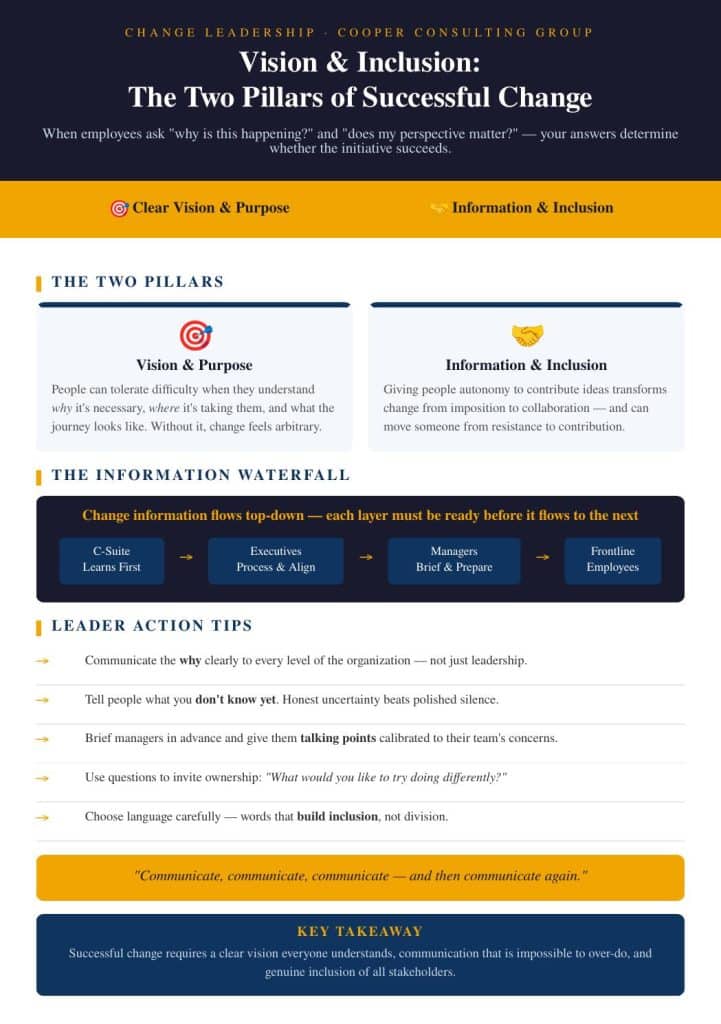
It is impossible for change to be successful unless the people enacting it have a clear understanding of why it is happening and where it is headed. What problem is the change solving or what opportunity is it pursuing? Leaders must communicate the answer to that question, the vision for the change, to every level of the organization.
A defined mission that everyone understands allows people at all levels of the organization to make strong decisions to support the purpose of the change and move toward that bigger goal. Without a clear purpose for the change, it’s easy for goalposts to move, leading to accomplishing little in the long run. Without this understanding, an organization is likely to stumble through the change, simply hoping to land somewhere useful instead of moving intentionally and strategically toward its vision for the future.
Organizations that communicate a clear, consistent rationale for change give employees something to orient around, even when the transition is uncomfortable. People can tolerate difficulty when they understand why it’s necessary, where it’s taking them, and what the journey to get there will look like. It becomes a temporary obstacle on the path to something greater. What people struggle to tolerate is feeling like change is being done to them arbitrarily, with no coherent direction and no one accountable for the outcome.
Communicate, communicate, communicate — and then communicate again.
Information and Inclusion
During any organizational change, people want two things above all else: information and inclusion. They want to know what is happening, why it is happening, and what their role looks like in the new vision. And they want to feel that their expertise and perspective are valued.
Giving people the autonomy to contribute ideas during a change transforms the dynamic from one of imposition to one of collaboration, and can even help move someone from resistance to contribution. You use questions to invite them to take ownership of their role in the change, like, “What would you like to try doing differently?”
Inclusion also means telling people what you don’t know yet. Leaders who wait until they have complete information before communicating anything leave a vacuum for people to fill with speculation. An honest “Here’s what we know, here’s what we’re still working through, and here’s when we’ll update you,” does more to maintain trust than a polished announcement delivered weeks too late.
The Information Waterfall
In most organizations, change information flows from the top down. The C-suite learns first, then executives, then managers, then frontline employees. This waterfall effect is natural, but it means that each layer must go through their own psychological transition before they are ready to communicate the change to the next level. Leaders at every layer need the tools and support to manage that process.
As the information gets disseminated, each leader needs enough information to answer basic questions and enough time to move through their own initial reaction. A manager who is still processing their own anxiety about a change will communicate it poorly to their team, regardless of how good the messaging is. It’s helpful to brief managers in advance, give them space to ask questions, and provide talking points calibrated to their team’s concerns. Doing so can dramatically improve how the change lands at the frontline level. The waterfall only works when each layer is ready before it flows to the next.
Choose Language Carefully
The language an organization uses around change shapes how it is perceived. For example, during a merger, calling longtime employees “legacy” employees implies that those individuals are outdated and uncommitted. Words create culture. Choose words that build inclusion rather than division.
The same principle applies to framing the change itself. Describing a restructuring as an “opportunity for growth” when everyone knows it involves layoffs destroys the credibility of the leadership. Employees read the gap between leadership language and observable reality. Especially when the news is hard, choose honest language that respects the people receiving it.
Bringing It Together
Vision and inclusion are not sequential steps. They work together throughout the life of a change initiative. Vision gives people a destination to move toward; inclusion gives them agency in how they get there. By providing both, you build trust with your team and give them the direction they need to keep moving.
| Key Takeaway: Successful change requires a clear vision that everyone understands, communication that is impossible to over-do, and genuine inclusion of all stakeholders. |