
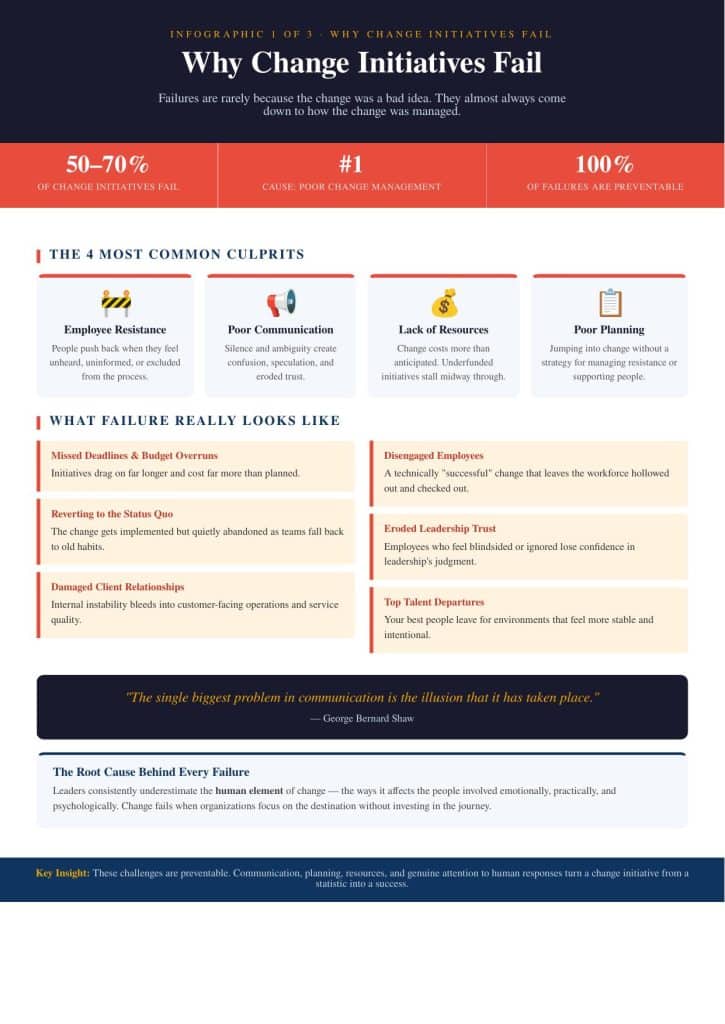
Organizational change is expensive, disruptive, and demanding, so it’s no wonder 50–70 percent of change initiatives fail. And when they do, the costs can be extreme, from wasted time and financial resources to damaged client relationships and lost employee talent.
These failures are rarely because the change itself was a bad idea. Generally, failed change initiatives come down to how the change is managed.
So where do so many organizations go wrong?
Leaders often underestimate the human element of change, the ways in which it will affect the people involved. The most common culprits of failed change initiatives are employee resistance, poor communication, lack of resources, and poor planning.
The good news is that these challenges are preventable with a strong strategy for change leadership.
Employee Resistance
When a change is unpopular, resistance can slow or even halt the initiative entirely. Leaders often believe their employees’ reactions are outside their control, but resistance is frequently a symptom of something that could have been addressed earlier. Usually it is a result of the leaders not providing enough communication, time to process, or employee involvement in the change.
Resistance is feedback, not obstruction.
Treat resistance as diagnostic information. An employee who pushes back loudly is telling leadership that they feel unheard, lack information, or see a problem with the plan that leadership has not considered. The longer those signals go ignored, the harder they become address and the more damaging they can be to the initiative.
Get ahead of employee resistance by identifying the people most likely to struggle with the change before the rollout begins. Those people might struggle with change in general, or they may have legitimate concerns rooted in institutional knowledge leadership doesn’t have. Bringing those people into early conversations, asking what they see, and making adjustments based on what they share can convert potential resistors into champions of change. A person who helped shape a change is far more likely to promote it.
Poor Communication
Perhaps the most common failure point is a lack of early and sustained communication about every aspect of the change. When people don’t understand what is happening, why it is happening, and what their role in the initiative looks like, they become confused and make assumptions that can lead to chaos.
It is virtually impossible to over-communicate during a change. Effective leaders communicate through multiple channels, check in to ensure understanding, and repeat key messages far more times than feels necessary.
Timing matters as much as frequency. Leaders who announce a change and then go quiet while planning implementation details create a vacuum of information that employees will fill with speculation. Set a communication rhythm from the start: here is what we know now, here is when we will update you next, and here is how to ask questions in the meantime. Even an update stating
“we don’t have answers yet” helps maintains trust better than silence does.
“The single biggest problem in communication is the illusion that it has taken place.” — George Bernard Shaw
Lack of Resources and Poor Planning
Change costs more than most organizations anticipate. Leaders who underestimate the resources needed often find their initiatives stalling midway through. Strong change management requires planning challenges that will arise unexpectedly and leaving buffer room of additional time and resources to address them.
Poor planning often results in organizations jumping into change without a strategy for how to manage resistance and support people through the transition.
The PGA/LIV Golf merger of 2023 provides a high-profile example, when the companies announced a major change without consulting key stakeholders: the players themselves. The result was anger, eroded trust, and a merger that took years to finalize.
Stakeholder mapping is one of the most underused planning tools in change management. Before a change is announced, identify every group affected and the impact they’ll feel, then design specific communication and support for each group. The PGA example failed because the people with the most at stake learned about the merger the same way the public did. Mapping stakeholders early forces leaders to think through the human architecture of a change, not just the operational one.
What Failure Really Looks Like
Failed change can be as dramatic as the organization collapsing or as simple as implementing new processes that cause more problems than they solve. Often, failed change is just inefficient change, whether that means never reaching the goal the initiative set out to reach or simply requiring more time and resources than planned. That might look like missed deadlines and budget overruns, or like an organization reverting to the status quo after the change falls apart. And in some cases, it looks like a change that technically gets implemented but leaves an organization hollowed out with disengaged employees, eroded trust, and top talent heading for the door.
| Key Takeaway: Change fails when organizations focus on the destination without investing in the journey. Communication, planning, resources, and genuine attention to human responses are what turn a change initiative from a statistic into a success. |